
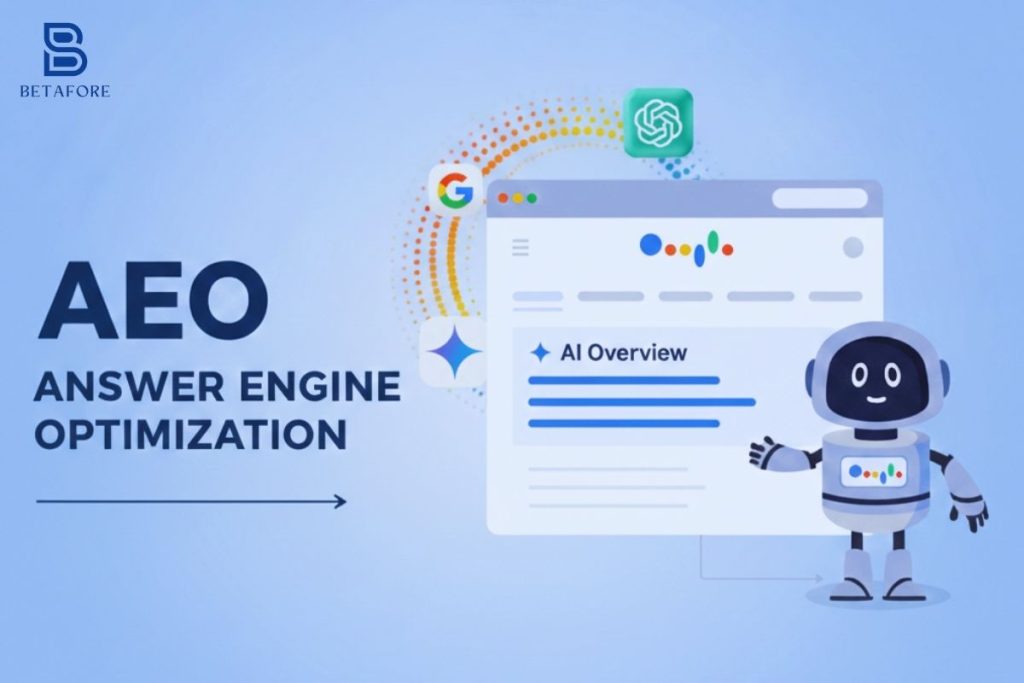
AEO is a new way to make sure your content gets picked as the direct answer when people ask questions online. Instead of just showing your website in search results, AEO helps AI tools, voice assistants, and chatbots give your content as the best answer right away. Today, people want quick, clear, and easy-to-understand answers. That’s exactly what AEO does. Whether it’s Google’s AI answers or ChatGPT-style responses, AEO makes sure your brand is seen in this new way of searching.
Easy steps to help your content become the answer:
1. Understand what people are really asking.
2. Organize your content clearly so it’s easy to read.
3. Write in simple, natural language that AI can easily understand.
4. Add schema markup, bullet points, tables, and clear headings so AI tools can quickly find the right answer.
5. Get brand mentions, citations, and reliable backlinks so AI systems trust your content as a reliable source.
Table of Contents
Understanding Answer Engine Optimization (AEO)
Answer Engine Optimization (AEO) is the practice of designing content and architecture so that AI-powered platforms like Siri, Google Assistant, Gemini and ChatGPT deliver your brand or content as a direct answer. Where traditional search engine optimization (SEO) seeks to rank you on page results, AEO aims to make your content the answer that users see. In other words, when someone asks a question like “what is answer engine optimization?”, the AI engine returns your content as the best answer.
Traditional SEO helps your website appear higher in search results. AEO, on the other hand, focuses on making your content the actual answer people see. For example, if someone asks, “What is AEO?” and your content is properly AEO-optimised, then AI will show your content as the best answer.
What You Need to Do for AEO (Answer Engine Optimization):
- Embed proper schema markup to help AI understand your content
- Structure headings clearly (H1, H2, H3) for easy scanning
- Use bullet points and tables to present direct answers
- Write clear, concise answers for common questions
- Optimize content for conversational and voice search queries
- Use natural, human language instead of keyword stuffing
- Build external citations and brand mentions to increase trust
- Strengthen topical authority across related content
- Keep content accurate, fresh, and well-structured
- Combine AEO with SEO for best results
- Use SEO for crawlability, keywords, and backlinks
- Use AEO to appear in AI answers, snippets, and voice assistants
How Answer Engines Work
Answer engines are search tools designed to provide direct answers instead of a list of links. Unlike traditional search engines, answer engines use natural language processing (NLP) to interpret queries and match them with precise content. They analyze questions, context, and intent to deliver relevant results quickly. These systems rely heavily on structured data, semantic analysis, and AI-driven algorithms to understand content meaning rather than just keywords.
For example, when a user types “best laptop for graphic design,” an answer engine scans web pages, knowledge graphs, and Q&A sources to provide the most relevant and concise answer. This reduces the need for users to click multiple links. Businesses that optimize content for answer engines can capture these high-intent queries, increasing visibility and trust.
Answer engine optimisation (AEO) focuses on providing concise, accurate, and structured content that aligns with user intent. Structured formats like tables, bullet points, FAQs, and schema markup improve chances of being featured in direct answers. Companies investing in AEO can outperform competitors by appearing at the top of voice searches, snippet boxes, and smart device results.
Which Answer Engines to Focus on for Business
Businesses must focus on the answer engines most relevant to their audience. Google remains the dominant answer engine globally, powering both web and voice searches through features like Featured Snippets, People Also Ask boxes, and Knowledge Panels. Optimizing for Google ensures the highest reach and credibility.
Other platforms like Bing, Siri, Alexa, and Google Assistant are increasingly important for voice search. Local search engines, such as Yelp or TripAdvisor, act as answer engines for industry-specific queries, especially in hospitality, food, and services. Optimizing for these platforms involves creating structured data, FAQ sections, and highly specific, actionable content.
Businesses must prioritize platforms where their audience searches for answers. Tech companies, for instance, should focus on Google Assistant and Siri for voice queries. Local service providers should prioritize Google Local Pack and review-driven platforms. A focused strategy ensures maximum visibility while reducing wasted effort on less impactful engines.
Why AEO Matters in the Future of Search
AEO matters because the nature of search is changing fast. More users now rely on voice assistants, chatbots, and AI platforms rather than traditional search result pages. For example:
What does that mean for brands? If your content is not optimized for AEO, you risk becoming invisible in the surfaces that matter most. Voice search, chat results, AI-overviews—all these are “zero-click” surfaces where users don’t click to a website. You need to be seen there. For organizations asking how to solve aeo, this means change is urgent. The table below illustrates differences between SEO and AEO:
| Feature | Traditional SEO | Answer Engine Optimization (AEO) |
| Primary goal | Rank in search results pages | Be cited as the answer in AI responses |
| Typical queries | Keywords or short phrases | Natural language questions |
| Content format | Long-form, keyword-focused | Direct answer first, then support details |
| Key signals | Backlinks, keywords, domain authority | Brand mentions, structured data, authoritativeness |
| Metrics | Ranking, clicks, traffic | Answer citations, zero-click visibility, brand mention share |
Therefore, brands that ignore how to solve aeo risk losing out in future search scenarios. AEO gives you visibility where users ask questions conversationally and expect direct answers. By optimizing for AEO you future-proof your content, maintain traffic, and strengthen brand presence in AI-driven discovery.
Key Strategies for Optimising Content for AEO
If you ask “how to solve aeo” for your brand, here are key strategies to adopt. These strategies help ensure your content is built for answer engines, not just search engines.
1. Understand user intent and map questions
Begin by identifying the precise questions your audience asks. What do they want answered? Then craft content that maps to those exact queries. This helps align with AEO.
2. Provide direct answer up-front, then expand
In each article or page, start with a concise answer (one or two sentences) that fully addresses the question. Then follow with supporting paragraphs. AI engines favour clear lead summaries.
3. Use structured formatting (headings, bullets, tables)
Break content into headings (H2, H3) and use bullet points and tables. This formatting makes your content machine-friendly and easier for AI to extract.
4. Add schema markup and structured data
Use schema.org markup (FAQ schema, HowTo schema, etc.) to help answer engines understand your content. Structured data is a strong signal.
5. Build authority, brand mentions and citations
AI engines trust sources that are referenced across the web. Build external mentions, backlinks, reviews, citations and strong brand presence.
6. Track, refine and iterate
AEO is still evolving, so you must set KPIs (citations, brand mentions in AI answers) and monitor how your content performs. Refresh and optimize when you lose visibility.
7. Blend AEO with your existing SEO work
Don’t abandon SEO. Use your SEO foundation (site speed, mobile friendly, keyword research) and layer AEO tactics on top. They work together.
By applying these strategies deliberately, you answer the question how to solve aeo in a practical way. You shift from passive ranking to active answer positioning. This gives you an edge in both voice search and AI-driven query surfaces.
The Role of AI and Voice Search in AEO
AI and voice search play a vital role in answer engine optimization (AEO). Because users now speak questions or type full sentences, the role of natural language processing (NLP) becomes central.
AI-powered answer engines
Platforms like ChatGPT, Claude, Gemini, Microsoft Copilot and Perplexity use large-language models (LLMs) to process queries and deliver answers instead of traditional link-lists. These answer engines value clarity, context, and structured data. For those aiming to figure out how to solve aeo, you must tailor your content to feed these engines.
Voice search and conversational queries
Voice assistants like Siri and Google Assistant amplify the need to use natural language. Queries begin with “how,” “what,” “why,” “can,” etc. AEO content must sound like spoken language and provide immediate value.
Natural Language Processing (NLP) and context recognition
Answer engines employ NLP to assess user intent, context, and semantics. They look for content that directly answers the question, recognizes entity relationships, and offers trustworthy data. To solve AEO-related challenges, you must write clearly, use simple sentences, optimize for NLP by repeating key phrases early, and provide synonyms and context where needed.
Thus, how to solve aeo for voice and AI search means crafting content that:
- Uses question-style headers (eg “What is AEO?” “How to solve AEO challenges?”)
- Opens with the answer then adds detail
- Provides supporting data and citations
- Uses short sentences (consistent with NLP best practices)
By doing this, your content becomes more likely to be surfaced by AI and voice-driven search results.
Measuring the Success of AEO Strategies
Once you implement AEO strategies, you must measure their success. Tracking performance lets you refine tactics and demonstrate value.
Metrics to monitor for AEO
Here are key metrics:
- Number of citations or mentions of your brand/content in AI-generated answers.
- Share of AI voice or zero-click answers your content occupies.
- Referral traffic from AI surfaces (where trackable).
- Brand mentions growth in conversational search results.
- Authority signals: backlinks, brand mentions, reviews that feed AEO trust.
Tools and challenges
Unlike SEO, AEO lacks mature universal tools. You may use specialist platforms or manual tracking. Combining analytics with manual queries (e.g., sample question -> monitor AI answer source) helps.
Setting goals and frameworks
When you ask how to solve aeo, set clear targets like:
- Earn your brand mention in at least 3 AI answers within 90 days
- Improve share of zero-click visibility by x%
- Increase branded conversational search volume by y%
Iteration and optimisation
AEO results evolve. Monitor which questions you show up for, which you don’t, and refresh content accordingly. Then test revisions, track changes, and scale the successful patterns.
By measuring success in these specific ways, you apply the same discipline you would in traditional SEO—but with new metrics suited to answer engines.
Additional Considerations
Content freshness and topical relevance
Answer engines favour up-to-date information. Refresh your content when facts, numbers, or examples change. Use dates and current citations to strengthen trust.
Localisation and multilingual optimisation
If your brand serves multiple regions or languages, optimize content for local conversational queries. Use local schema (local business), FAQ about local services, voice search variations.
Technical environment and crawlability
Ensure your website is crawlable by bots, uses HTTPS, has good speed, mobile optimization and proper internal linking. These foundations support both SEO and AEO.
Avoiding content duplication and thin answers
Quality matters. Short, vague answers hurt your chances. Provide comprehensive, unique responses. AI engines penalise thin or repetitive content.
Privacy, transparency and trust signals
Since AI answers often cite trustworthy sources, your site must display author info, credentials, references and clear editorial standards to feed trust signals.
Collaboration across teams
AEO demands collaboration between content creators, SEO specialists, data analysts and brand teams. For example, brand mentions in PR help AEO; schema markup requires dev team; question-mapping requires content team.
By minding these additional considerations, you enhance your ability to solve AEO challenges comprehensively, beyond pure content writing.
The Impact of AEO on Digital Marketing and Business Growth
Answer Engine Optimization (AEO) changes how digital marketing works and how businesses grow. It pushes brands to focus on clear, valuable answers instead of only ranking higher. When users search, they expect instant and trusted replies. If your brand gives those answers, you gain authority fast. Research shows that brands appearing in AI answer boxes see up to 25% more trust and engagement than others.
AEO connects with every area of digital marketing—content, social media, reputation, and user experience. It supports B2B visibility on platforms like Blueflame AI, Google AI Overview, and ChatGPT search. Businesses that learn how to solve aeo early see better lead quality and higher organic conversions.
In B2B, where decisions need clarity, being the “go-to answer” builds client confidence faster than ads. AEO also helps small brands compete with big names by rewarding relevance over ad spend. In short, AEO doesn’t just change search—it transforms marketing strategy. It lets you turn your knowledge into visibility, your visibility into trust, and your trust into long-term business growth.
In summary
How to solve aeo is the pressing question of modern digital marketing. Answer Engine Optimization (AEO) presents a shift from ranking links to being the answer. It matters because search is evolving toward AI chatbots, voice assistants, and zero-click surfaces. To optimise for AEO you must:
- Understand user intent and craft questions-based content
- Provide direct answers up-front, then expand with detail
- Structure your content with headings, bullets, tables and schema
- Build brand mentions, authority and citations
- Adapt for AI and voice search via natural language and NLP principles
- Track success with metrics like citations, share of zero-click visibility and brand mention growth
- Refresh and iterate content to maintain relevance, localisation, and technical soundness
How Industries Are Adapting to the Rise of Answer-Driven Search
Industries are increasingly adapting to answer-driven search by restructuring content to be concise, structured, and authoritative. Marketing teams are creating FAQ sections, knowledge hubs, and content snippets designed for quick consumption. This ensures their content is picked up by answer engines efficiently.
E-commerce businesses use structured product descriptions, comparison tables, and review highlights to provide direct answers for purchase-related queries. Healthcare and education industries provide guides, Q&A, and step-by-step solutions to meet users’ informational needs. By focusing on clear, semantic, and authoritative content, industries increase their chances of being featured prominently in search results.
Additionally, companies are leveraging schema markup, metadata optimization, and AI-powered content analysis to align with answer engine algorithms. This adaptation allows businesses to capture high-intent traffic, reduce bounce rates, and improve user engagement. The trend toward answer-driven search requires industries to prioritize clarity, accuracy, and structured content to maintain competitiveness.
Conclusion
The era of pure SEO is not over, but it is evolving. AEO complements and extends SEO by placing your content where users look first—at the answer. Brands that ask how to solve aeo and act will gain an edge in future search landscapes. Your next step: audit your current content, identify your key questions, apply AEO-friendly structure, and measure performance. Transition from “search ranking” to “answer ranking.” The future of search is here.
AEO FAQs
1. What does AEO mean in SEO?
AEO stands for Answer Engine Optimization. It’s the process of optimizing content so search engines like Google or Bing can easily find direct, clear, and structured answers to users’ questions. This helps your website appear in voice search, featured snippets, and AI-generated search results.
2. How is AEO different from traditional SEO?
Traditional SEO focuses on ranking web pages higher on search engine results pages (SERPs), while AEO focuses on delivering concise, factual, and structured answers that voice assistants and AI systems can use directly to respond to user queries.
3. Why is AEO important for the future of search?
With AI and voice search growing rapidly, users now ask conversational questions instead of typing keywords. AEO ensures your content is optimized to match this trend, increasing visibility and engagement in AI-powered search systems.
4. How can I optimize my content for AEO?
To optimize for AEO, structure your content using headings, schema markup, and concise answer-based paragraphs. Include FAQs, use natural conversational language, and make sure your content directly answers specific user queries.
5. What tools help improve AEO performance?
Tools like Google Search Console, SEMrush, and AnswerThePublic can identify questions your audience asks most. Structured data tools like Schema.org or Rank Math also help implement schema markup to enhance your content for AEO.